
A lot of people look for the magic home loan hack. Weekly repayments, fortnightly repayments, offset tricks, redraw strategies, credit card points, some bloke on the internet selling a course with a whiteboard and too much confidence.
Some of these things can help. But the basic mechanic is usually much simpler than people think, and once you see it, most of the tricks either collapse into it or stop mattering.
A home loan is basically a massive negative account
You owe the bank money. Your repayments push the balance down. The bank charges interest, which pushes the balance back up.
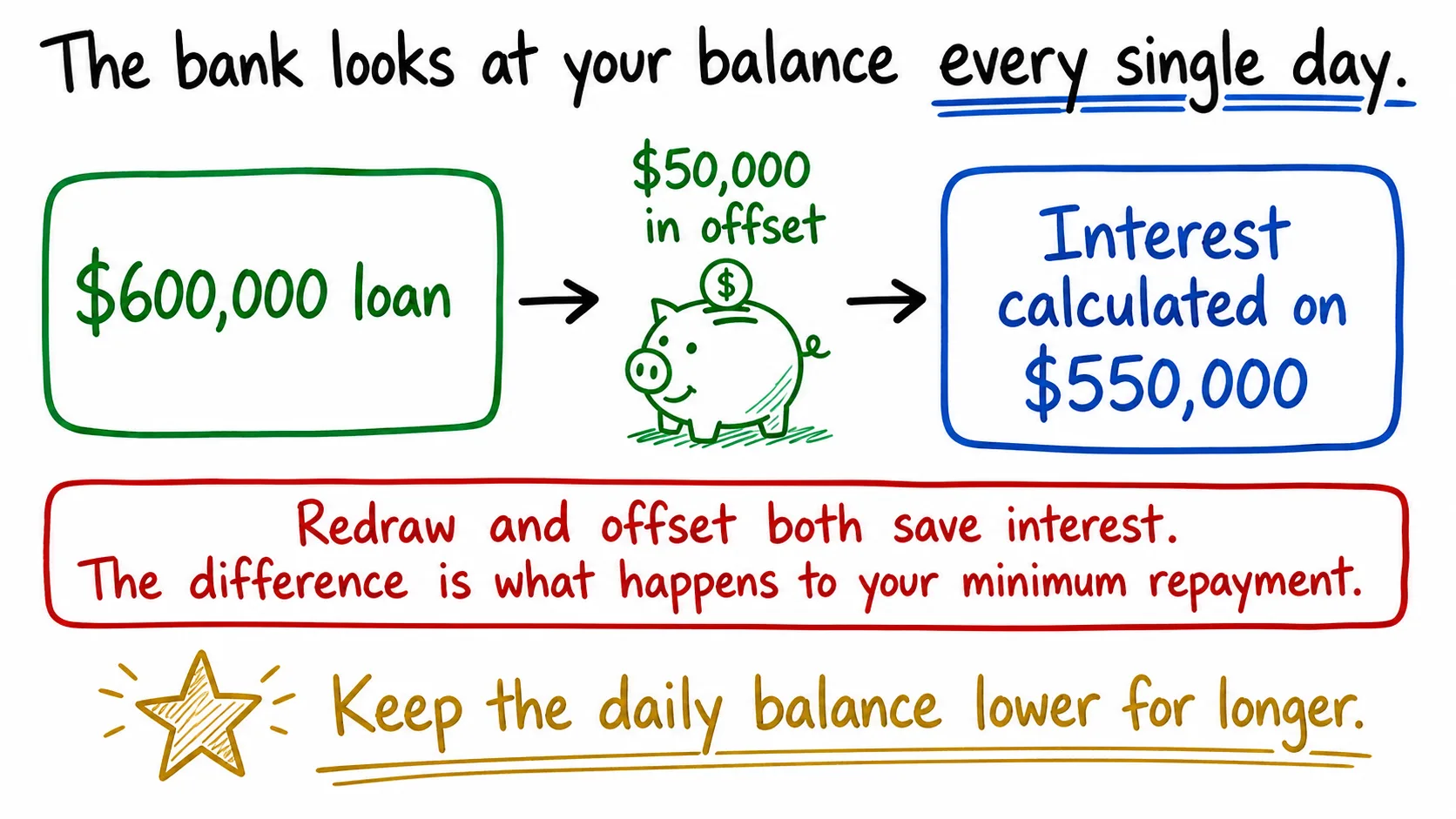
For most standard home loans, interest is calculated daily and charged monthly. The bank looks at your loan balance each day, calculates interest on that balance, and charges the total once a month.
So the whole game is one question: how do you keep the effective balance lower each day?
That is what extra repayments do. That is what offset accounts do. That is what putting money into the loan sooner does. That is what keeping your repayments higher after a refinance can do. They are all just different ways of attacking the daily interest calculation.
Why the loan feels so slow at the start
Where buyers often get stuck is thinking there are separate buckets. They ask, "Can I pay the interest first?" or "Can I make my repayment go to principal?"
On a normal principal and interest loan, that is usually the wrong mental model. Think of it more like a bill. The bank has calculated a minimum repayment that should clear the loan over the term, usually 30 years. You make the repayment, the balance comes down. The bank charges interest, the balance goes back up a bit.
At the start the balance is huge, so the interest charge is huge, and more of your repayment is effectively covering interest. Later, as the balance shrinks, the interest charge shrinks, and more of the same repayment starts attacking the actual debt.
That is why home loans feel painfully slow in the early years. It is not a mysterious "interest first" bucket. It is just a big balance.
What an offset account actually does
If you have a $600,000 loan and $50,000 sitting in offset, the bank calculates interest as though you owe $550,000. Your repayment usually does not drop, but the interest charged is lower, which means more of that same repayment goes towards reducing the loan.
Not magic. Just less interest charged, more principal paid down.
If your loan costs extra to include an offset, check whether your usual offset balance covers the extra cost.
Offset vs redraw: the difference people keep asking about
This is the question that came up most when I posted this on Reddit, so here is the plain version.
Money in an offset account and money in redraw both save you interest the same way: they lower the balance the bank calculates interest on. The practical differences are around access and repayments. As money builds up in redraw, the lender may recalculate your minimum repayment on the lower balance; an offset generally does not change your minimum repayment.
One wrinkle worth knowing: on an investment loan, pulling money back out of redraw can have tax consequences that pulling money out of an offset does not. If your loan is attached to an investment property, that is a conversation for your accountant before you move anything.
The weekly vs fortnightly debate is smaller than it looks
If you do not have an offset, paying money into the loan earlier helps because the balance drops earlier. But if your income and savings already sit in an offset account, that benefit is mostly already happening. The money is already reducing the daily calculation.
At that point the bigger question is not "am I paying weekly or fortnightly?" It is whether you are actually keeping surplus money against the loan, or just moving money around and spending it anyway.
The offset and fortnightly repayment comparison works through the difference between moving money sooner and paying more over the year.
The three quiet leaks
This is where people get caught, and none of it shows up in the rate comparison.
- The redraw leak. Extra repayments go in, feel great, then slowly come back out for holidays, cars and renovations. Years pass and the loan has barely moved.
- The refinance reset. You switch to a better rate, the loan resets to 30 years, the minimum repayment drops, and you spend or save the difference instead of paying it into the loan. The rate got better but the clock started over. Extending the term is not automatically a mistake, and I extend loans deliberately when a client has a specific goal, but it only works if you keep paying what you were paying before and treat the lower minimum as a safety net.
- The pay rise leak. Income goes up, repayments stay the same, and the whole rise disappears into lifestyle creep.
The boring checklist
- Keep spare cash in offset if you have one.
- Pay more than the minimum where your budget allows.
- Do not redraw unless you actually mean to.
- Be careful resetting the loan term, or keep repayments at the old level if you do.
- Keep the effective loan balance lower for as long as possible.
What to do next
If your loan has been sitting untouched for a few years, the useful exercise is not hunting for a hack. It is checking three things: where your spare cash sits, what your repayment is doing relative to the minimum, and whether your loan structure still matches how you actually use money. If you are thinking about a refinance, it is also worth understanding how equity works before you reset anything.