
A lot of buyers get confused when they speak to two brokers and receive two different borrowing capacity numbers.
One broker says they can borrow around $720k. Another says maybe closer to $800k. The natural reaction is: who is wrong?
Sometimes that is a fair question. A number can be wrong if someone has missed HECS, ignored a credit card limit, used income the lender will not actually accept, or made assumptions that are too generous.
But there is another reason this happens: borrowing capacity is not one fixed number.
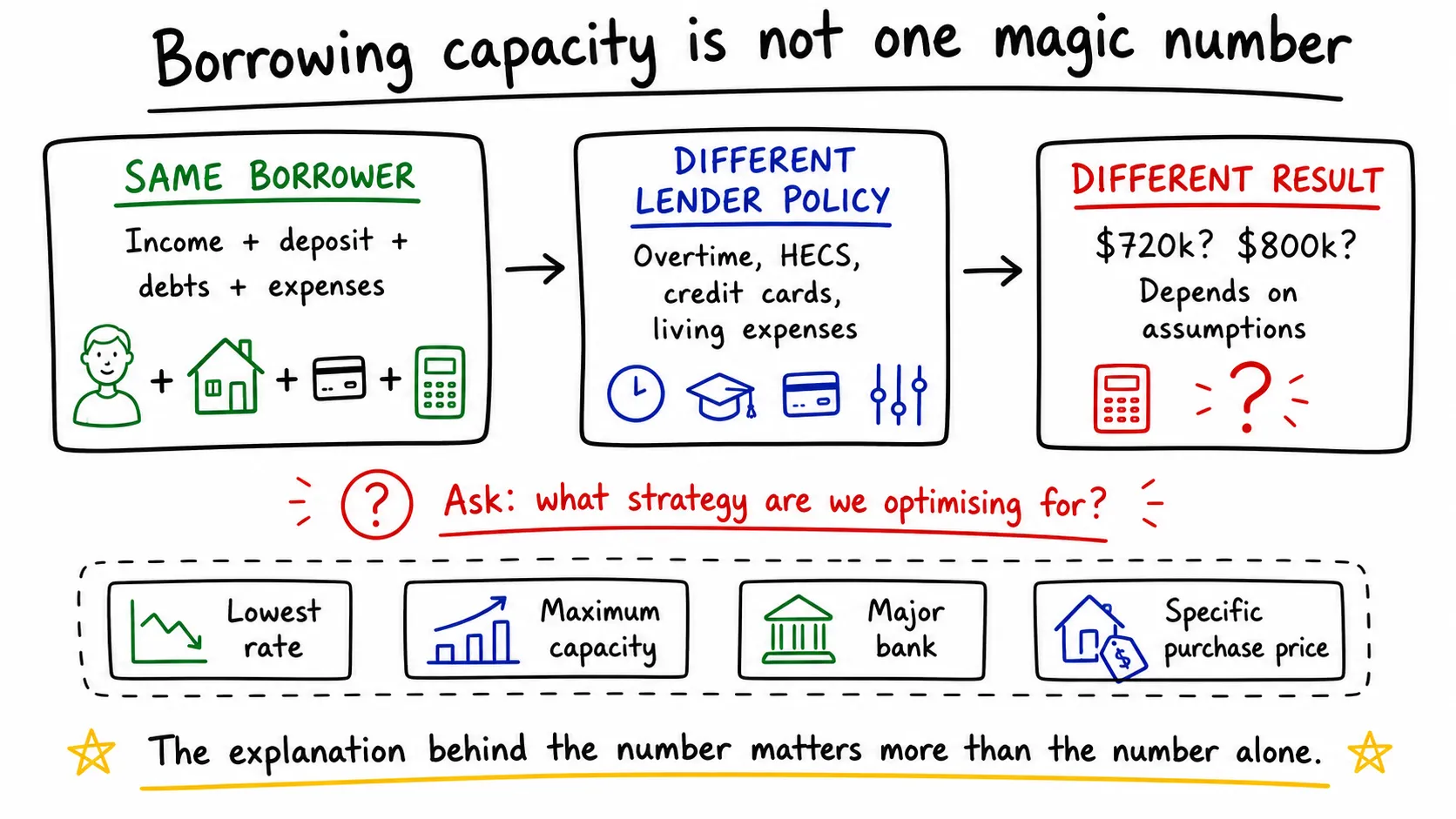
Borrowing capacity depends on the lender
Different lenders assess the same borrower differently. One lender might be better with overtime. Another might be better with bonus or commission income. Another might treat HECS, dependants, living expenses, credit cards or existing debts differently.
Some lenders are sharper on rate but tighter on servicing. Others may be more flexible but more expensive. That means the "maximum borrowing capacity" can change depending on which lender is being tested.
The better question is: what are we optimising for?
When someone asks, "How much can I borrow?", the better question is often, "What are we trying to achieve?"
- Are we trying to find the cheapest suitable lender?
- Are we trying to stay with a major bank?
- Are we trying to maximise borrowing capacity?
- Are we trying to hit a specific purchase price?
- Are we trying to work out whether paying off debt helps more than keeping cash?
Those are not always the same answer.
Where the strategy comes in
A broker should be more than an order taker. The value is not just typing numbers into a calculator and saying, "Here is your number." The value is working out what the borrower is trying to achieve, then comparing the lender options and trade-offs.
Maybe a mainstream lender gets you enough borrowing capacity and has a sharp rate. That can be a clean outcome.
But maybe the cheapest lender does not quite get you there. Then the conversation becomes more strategic. Do we reduce a credit card limit? Pay out a car loan? Use a lender that treats your income more favourably? Accept a slightly higher rate to get the capacity needed? Lower the purchase price? Wait and build more savings?
None of these are magic tricks. They are trade-offs.
Questions to ask when numbers differ
If two brokers give you different borrowing capacity numbers, do not only ask which one is right. Ask what is sitting underneath the number.
- Which lender or lenders were used for the estimate?
- Was the number based on verified documents or rough assumptions?
- Were HECS, credit cards, dependants and existing debts included?
- Was overtime, bonus, commission or self-employed income treated conservatively?
- Is the strategy aiming for lowest rate, maximum borrowing, or a balanced option?
- What would need to change to increase capacity safely?
The real goal
The real goal is not just getting the biggest number. It is finding a lending strategy that matches the property target, repayment comfort, lender policy and long-term plan.
The result depends on which lender and assumptions the assessment uses.