Most people think of refinancing as "moving my home loan to another bank for a better rate."
That is often the reason people start looking, and fair enough. If your rate is not competitive, it makes sense to see what else is out there. But refinancing is not just changing the rate on your current loan, and understanding what actually happens explains almost everything else about the process.
A refinance is a new loan replacing the old loan
Mechanically, that is the whole thing. The new lender approves a fresh loan, that loan pays out your old lender, and the new lender takes over the mortgage on the property.
Same house. New loan.
A simple example. You owe Bank A $500,000. You apply with Bank B. Bank B approves a new loan. At refinance settlement, Bank B sends the money to Bank A, Bank A closes your old loan and removes its mortgage from the property, and Bank B registers its mortgage instead.
This is why a refinance still involves an application, a valuation, loan documents and a settlement. The new lender is not inheriting your old loan because you have been making repayments. They are writing a brand new one, so they want to check your income, debts, credit conduct, property value, loan amount, loan purpose and whether the whole deal fits their policy.
The four jobs a refinance can do
- A better rate. The obvious one.
- A better structure. Adding an offset account, splitting fixed and variable, or moving to a lender whose features suit how you actually use money.
- Consolidating debt. Rolling other debts into the home loan, which lowers the rate on them but can stretch them over a much longer term.
- Releasing equity, often called cash out. This is the one people get confused about, so it gets its own section.
Equity is not an ATM
Equity is the difference between what your property is worth and what you owe. If your home is worth $800,000 and your loan is $500,000, you have $300,000 in equity.
But that does not mean you can withdraw $300,000 like cash. Lenders will not let you borrow against every dollar of equity. They have a maximum loan-to-value ratio they are comfortable with, and they still need to assess whether you can afford the higher loan.
Same example with numbers. Property value $800,000, current loan $500,000. If the lender is comfortable going to 80% LVR, the total loan could be up to $640,000. That means there may be around $140,000 of usable equity before costs, not $300,000.
If you refinance from $500,000 to $640,000, the first $500,000 pays out the old loan. The extra is the cash out.
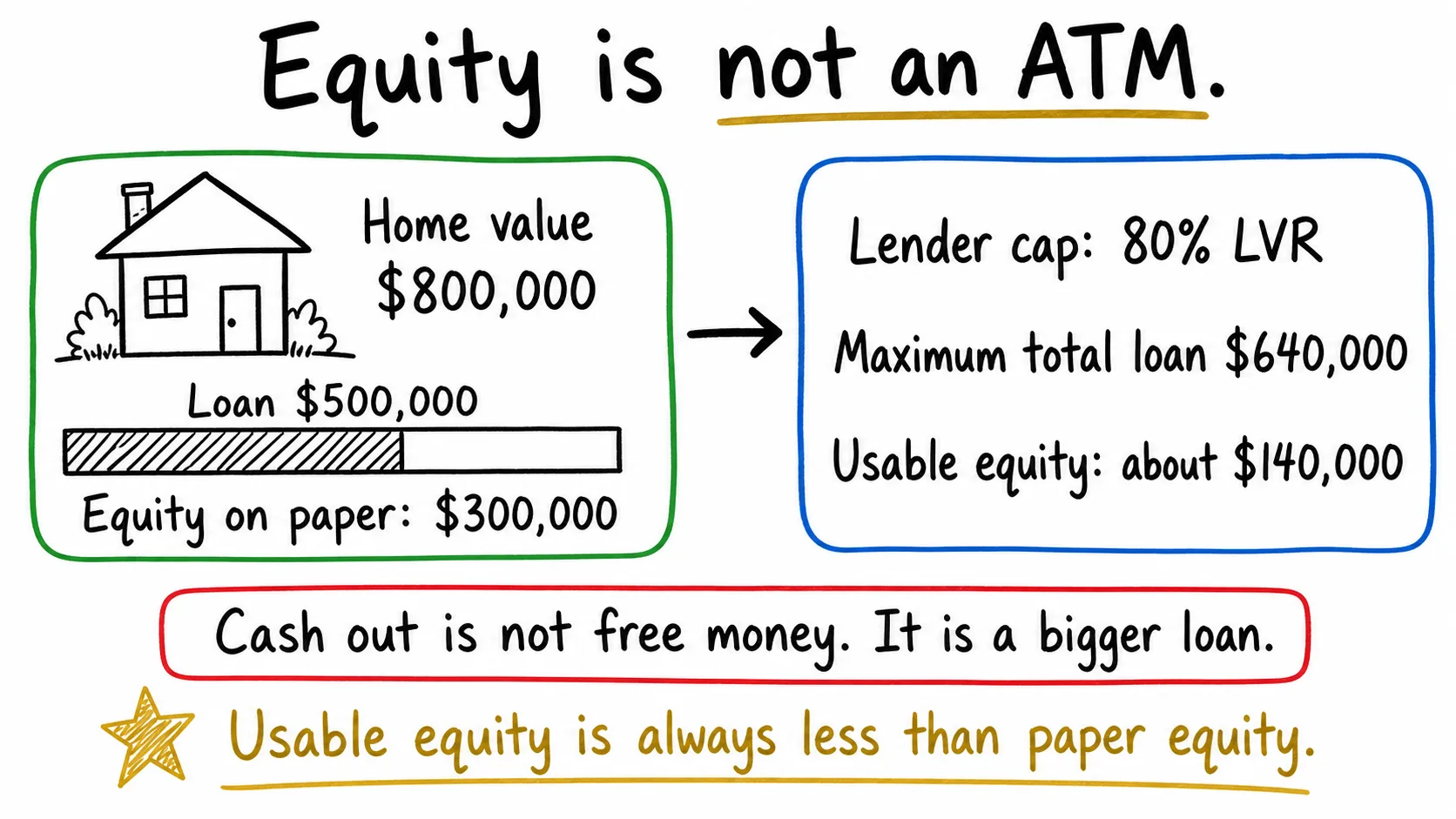
Cash out is not free money
You have not been given anything. You have increased your home loan, and you will be paying interest on the extra for as long as it is there.
The lender will also usually want to know what the money is for. Different lenders have different rules around cash out. Some are comfortable with larger amounts if the purpose is clear. Some want quotes, invoices, contracts or a written explanation. Most get cautious when the purpose is vague or speculative.
Some purposes are cleaner than others. Renovations with quotes can be fairly straightforward. Debt consolidation may involve the lender paying out the debts directly. Funds for an investment property deposit usually need to line up with the broader purchase plan.
So "I have equity" is not the full answer. The real questions are: what is the property worth, what do you owe, what LVR will the lender accept, can you afford the higher loan, what are the funds for, and what evidence will the lender want.
What refinancing costs
A common cost is the discharge fee from your existing lender, often somewhere around the $350 mark. There are also government mortgage registration and discharge fees, and the new lender may charge establishment or settlement fees. If part of your loan is fixed, break costs can change the picture entirely, so check those before anything else.
As a rough rule, I usually budget around $1,000 for refinance costs. It can be cheaper, and it can be more, depending on the lender, the state and the loan structure. Some lenders waive fees or offer cashback, but I would still treat a refinance as a transaction with costs, not a free rate change.
The payback question
If you spend around $1,000 to refinance and save $200 a month, you recover the cost in about five months. Fairly easy yes.
If you save $20 a month and create a pile of admin, it may not be worth rushing. The maths is not complicated; it just needs to actually be done rather than assumed.
Watch the loan term
A lower repayment after refinancing is not always because the rate is better. Sometimes the repayment is lower because the loan has been stretched back out to a longer term.
That might be fine if cash flow is the goal. But it is worth knowing what is actually causing the lower repayment, because a reset term with a lower minimum can quietly cost you years of interest if you drop to the new minimum without noticing. There is more on that trap in the article on paying your loan off faster.
The questions to ask before you move
- What will it cost to move?
- How much will I actually save?
- How long until the refinance pays for itself?
- Is the loan term changing?
- Am I borrowing more?
- Is the structure better?
- Am I improving the loan, or just making the repayment look smaller?
What to do next
Refinancing can be a very good move. It can cut your rate, improve your structure, clean up debts, or release equity for a specific goal. The main thing is understanding what is actually changing: a refinance is a new loan replacing the old loan, cash out means borrowing more against the property, and the deal needs to make sense after costs, not just on the headline rate.
If you want the decision checklist rather than more mechanics, start with the refinancing and equity review guide. It compares staying, repricing, restructuring and moving lenders in one place.