I find a lot of people use brokers with the wrong mental model.
They treat a home loan a bit like an NBN plan, a phone plan or an electricity provider. Basically, "who has the cheapest price?"
And look, I get it. I love a bargain as much as anyone. You should care about the rate; a small difference on a large loan adds up. But with home loans, the cheapest rate is not always the full answer, because you are not just buying a product. You are trying to get a lender to approve your specific situation.
The loan is a commodity. The approval is not.
Once a loan is set up, money is money. You make repayments, pay interest, and hopefully the lender leaves you alone.
But getting the loan approved is a different game. Banks have different policies, different risk appetites, different ways of reading income, different rules around deposits, different comfort levels with property types, and different tolerances for anything slightly outside the box.
So when someone opens with "what is the best rate you can get me?", it is not a bad question. It is just usually too early.
Why "best rate" without context is a trap
The trade-offs can matter a lot more than the last decimal place:
- One lender might have a cheaper rate but give you $80,000 less borrowing capacity.
- One might be great for simple PAYG income but weak for self-employed income.
- One might be strict on genuine savings; another better with overtime, allowances, bonus or commission income.
- One might be fine with you as the borrower, but not love the property you are buying.
Sometimes the cheapest lender is still the right lender. Great, easy win. But sometimes the cheapest lender is not the one that gives you the result you actually need, and that part does not show up on a comparison website. It is the same reason two brokers can quote you different borrowing capacities: the answer depends on which lender is doing the reading.
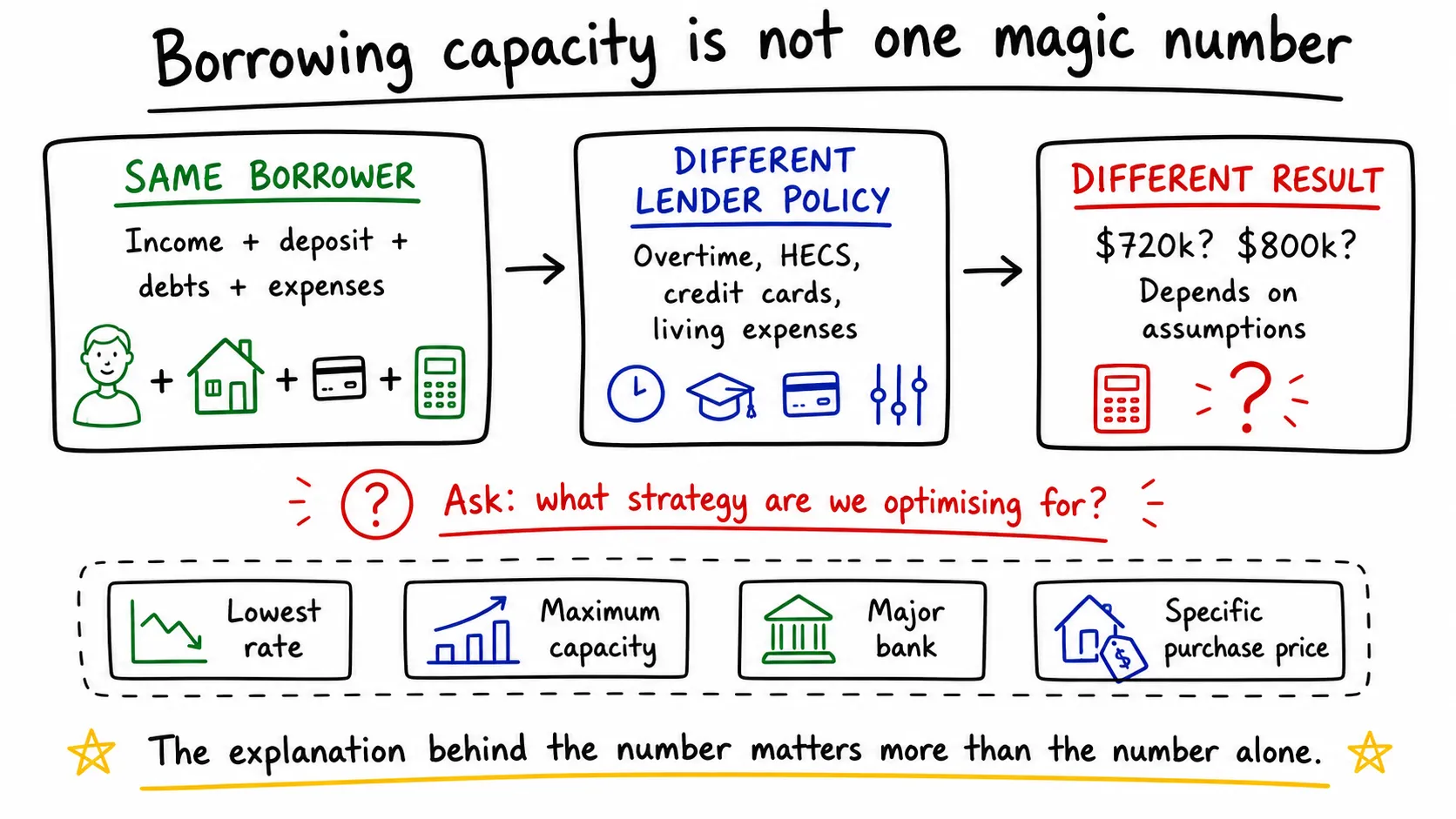
The details that change the answer
A broker can do a much better job knowing: what you are trying to buy and the price range; how much deposit you have and where it came from; whether you are self-employed; whether your income includes overtime, bonuses, casual hours, commission or allowances; whether you have HECS, dependants or any credit history wrinkles; whether you are keeping another property; whether a government scheme is in play; and whether the property is a house, townhouse, apartment, acreage, new build or something unusual.
Every one of those details can move which lenders are suitable and what you can borrow. That is not paperwork for its own sake. It is the actual input to the answer.
The better conversation
Instead of "beat this rate", try: "Here is what I am trying to do. Which lenders are actually a good fit, what are the trade-offs, and where does rate sit in all of that?"
Then make the broker show their working. Why this lender? What are the alternatives? What am I giving up, and what am I gaining? Is this recommendation about rate, borrowing capacity, speed, policy fit, approval confidence, or structure?
A good broker should be comfortable with every one of those questions, because the goal is not to avoid talking about rate. It is to work out what actually matters before pretending the cheapest number on a screen is automatically the best answer.
How to spot a good broker from your side of the desk
When I posted this on Reddit, the comments added the other half of the picture, and they were right:
- They ask you questions without being prompted. If a broker does not dig into your situation before talking solutions, that is a red flag. You should not have to drag the fit conversation out of them.
- They respect your time. Responsiveness is part of the product. Deadlines in property are real, and a broker who cannot manage their own time cannot manage your settlement.
- You click with them. Buyers who shopped around for a broker they trusted consistently report getting more value than those who grabbed the first name they were given. You are allowed to interview brokers.
- They can explain the trade-offs in plain English. If you cannot repeat back why this lender was chosen, the explaining is not done.
What to do next
Before your first (or next) broker conversation, spend ten minutes writing down your actual situation: goal, price range, deposit and its source, income shape, debts, property type. Hand that over at the start. If you want to see what the structured version of that conversation looks like, our home loan process page walks through it step by step.