
Whenever rates wobble, the same question fills my inbox: should I fix?
Here is how I actually explain it to clients, and it starts with being honest about what fixing is.
Fixing is a bet from one angle, insurance from the other
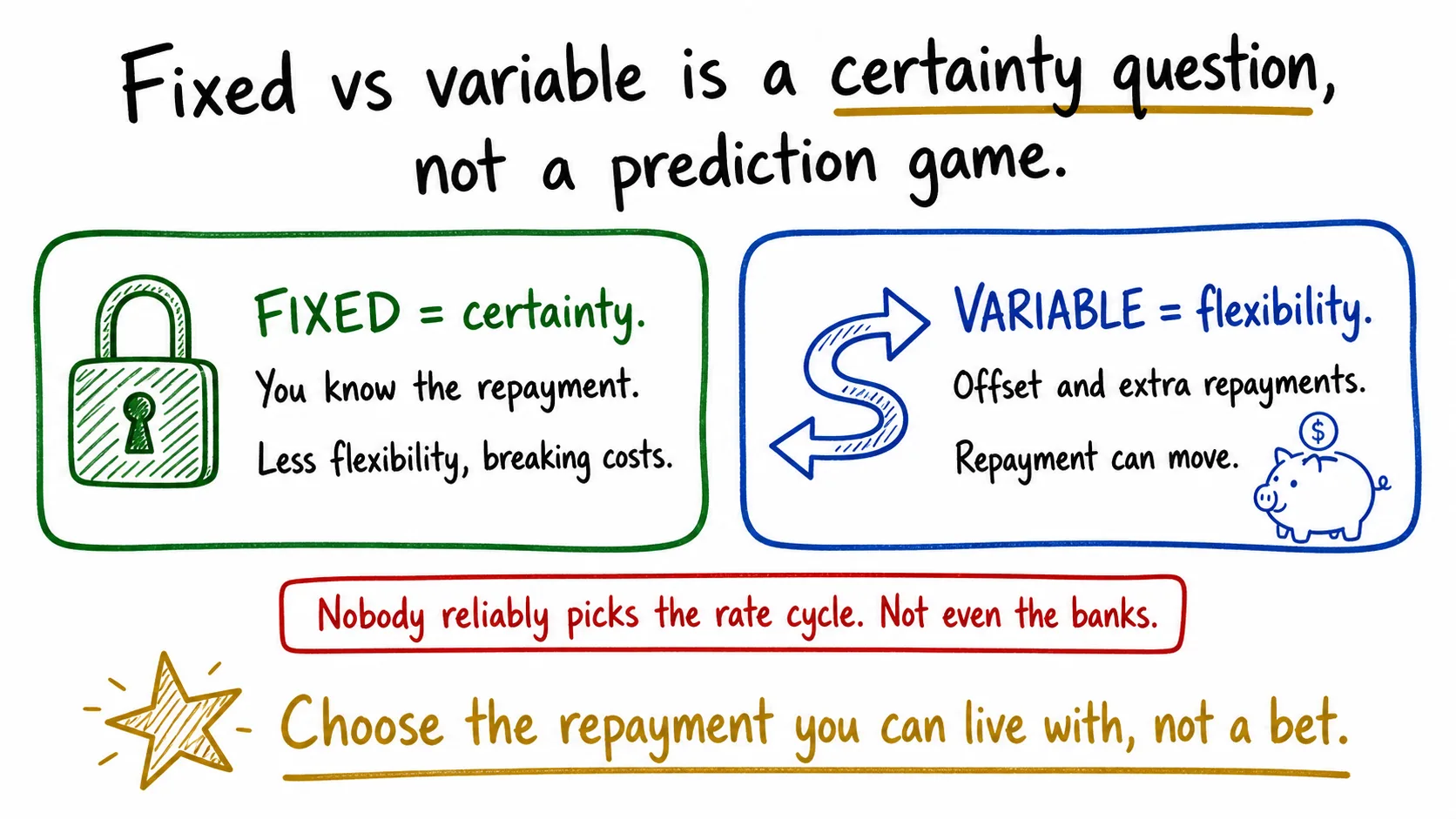
Fixing your rate is essentially a bet against the bank. You are betting rates go up, they are betting they will not, and they have teams of economists pricing that product. They are not offering it because they expect to lose money on it.
That does not mean you always lose. Sometimes the bet pays off. And there is a fairer way to look at the same transaction: fixing is also a hedge. You know for certain you can afford the fixed repayment; you cannot be certain you could afford whatever the variable rate does. Seen that way, you are not trying to beat the bank, you are buying certainty.
Both framings are true. The question is which one you are actually paying for, and whether you need it.
What you give up when you fix
- The ability to refinance freely. If a better deal comes along, breaking a fixed rate can cost real money. Break costs depend on rates at the time and can be large.
- Full offset functionality, in most cases. Many fixed loans have no offset or only a partial one, and extra repayments are usually capped.
- Flexibility if your circumstances change. Selling, restructuring or accessing equity mid-term all get more complicated.
The trade-off is certainty. And certainty has real value, but mainly if uncertainty would genuinely hurt you.
The stress test that replaces the crystal ball
Instead of guessing where rates go, work out what a 0.25% or 0.50% rise would actually cost you each month. On a $500,000 loan, a 0.25% rise moves the repayment by roughly $80 a month.
If that is manageable, staying variable keeps your options open, and a rise is an annoyance rather than a crisis. If that kind of rise would genuinely stretch your budget to breaking point, fixing some or all of the loan might make sense for the stability alone.
Notice what this does: it turns an unanswerable question ("where are rates going?") into one you can answer tonight with a calculator ("can I absorb a rise?").
You do not have to pick just one
Splitting the loan, part fixed and part variable, is common and often sensible. You get certainty on the fixed portion and keep offset and unlimited extra repayments on the variable portion.
If you do split, two practical notes. Keep your offset money working against the variable side, since that is where it saves interest. And if you have surplus beyond that, point it at whichever side carries the higher rate. The right split ratio depends on your cash flow, your buffer and how much certainty you actually need, not on a magic formula.
The timing trap
The moments when people most want to fix are usually right after rates have already risen, which is like buying insurance after the storm. Fixed rates are priced off where the market expects rates to go, not where they are today, so by the time a rise is obvious, it is usually already in the fixed price.
That is not a prediction about where rates go next. It is the opposite: an acknowledgement that if it is genuinely unclear which way things move, you are not missing something everyone else can see. Nobody reliably picks the cycle. Not even the banks, which is why they hedge.
What to do next
Run the stress test on your own numbers. If the answer is "a rise would be fine", the flexible structure probably suits you, and the better use of energy is keeping your daily balance down. If the answer is "a rise would really hurt", look at fixing some of the loan, and compare a couple of lenders rather than one, because fixed pricing varies more than variable. If your fixed term is about to expire, use the refinancing review checklist to compare staying, repricing and moving rather than simply accepting the roll-off rate.