
If you bought your home with a 5% or 10% deposit, there is a fair chance you are paying a targeted "risk rate" right now without knowing it.
I keep reviewing loans where the borrower is still on a noticeably higher rate because their bank still has them flagged as a 90% LVR customer, while borrowers under 80% LVR are being offered meaningfully sharper pricing. Depending on the loan size, that gap can cost thousands of dollars a year in extra interest.
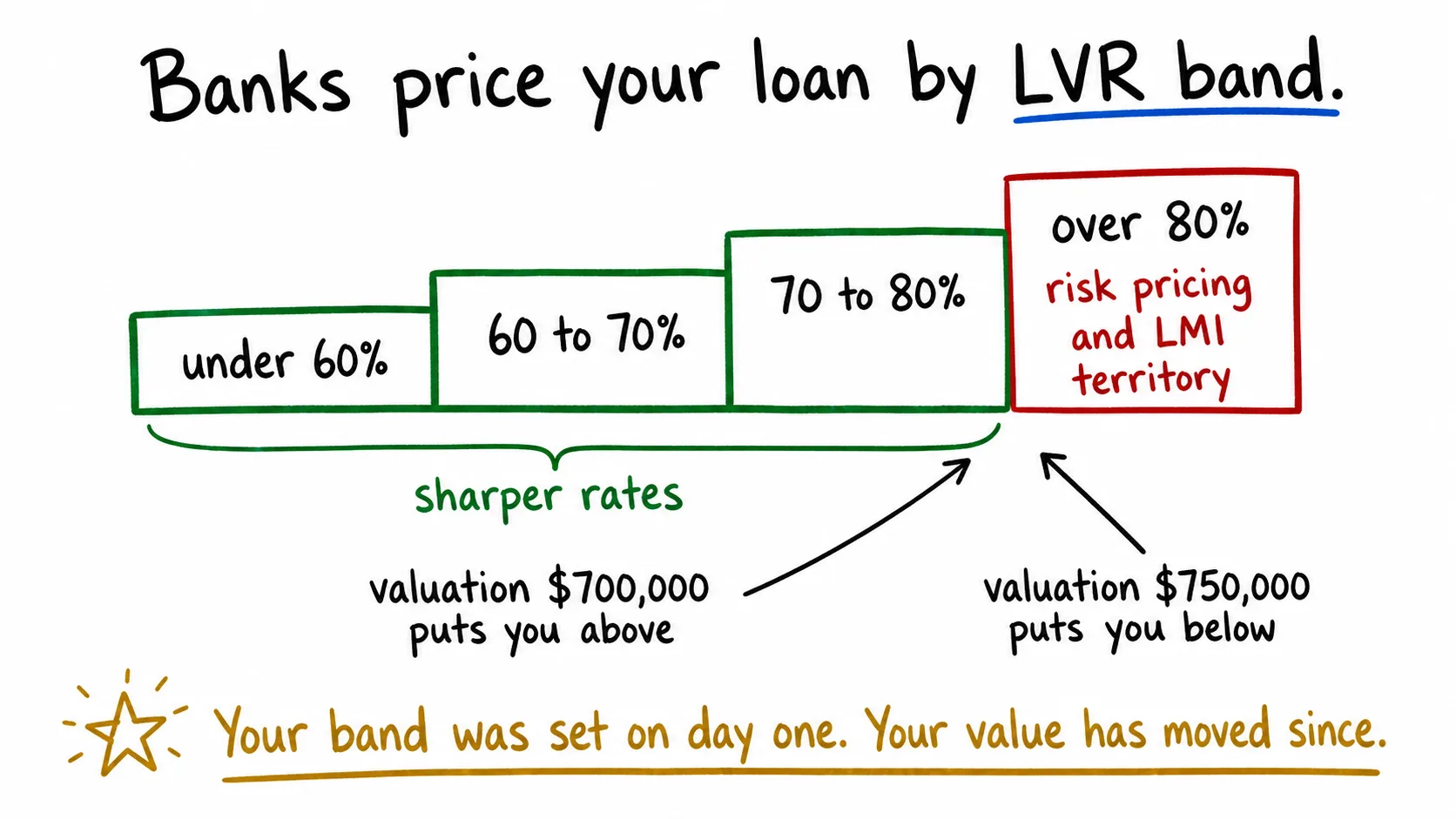
Banks price your loan by LVR band
Your loan-to-value ratio, or LVR, is your loan amount divided by what the property is worth. Lenders group borrowers into bands: under 60%, 60 to 70%, 70 to 80%, 80 to 90%, and above. The lower the band, the lower the risk to the bank, and the sharper the rate they are usually willing to offer.
The biggest cliff sits at 80%. Above it, you are in higher-risk pricing and usually LMI territory. Below it, you are in the competitive part of the market. Below 80% the bands still matter, but the gains get smaller, often in the order of a tenth of a percent per band rather than the big step you get crossing 80%.
Here is the catch: nobody reprices you automatically
You were a 90% borrower on day one. Since then you have made repayments and the property value may have moved. Your real LVR today might be 78%. But your bank generally will not run a new valuation on its own, and it will not shift you into the cheaper band uninvited. As far as their pricing is concerned, you are still the risk you were at settlement.
Fixing that is usually on you, or on your broker.
Valuation shopping
Different lenders value the same property differently. One lender's automated model might cap your home at $700,000 while another accepts $750,000. That difference can be the whole game: on a $560,000 loan, the first valuation has you at 80%, the second at under 75%.
So what we usually do is run upfront desktop valuations with a few different lenders before any application goes in. It costs nothing, it does not touch your credit file, and it tells us which lender's valuation gets your LVR under the threshold. If one comes back high enough to push you under 80%, refinancing to that lender can drop the risk premium for the remaining life of the loan.
The LMI-again trap
One serious caution before you rush off. If the best valuation still leaves you above 80% LVR, refinancing to a new lender usually means paying lenders mortgage insurance all over again. LMI you paid at your original bank does not travel with you. A refinance at 85% LVR that triggers a fresh LMI premium will usually wipe out the interest savings immediately.
If you are above 80% and the valuations will not stretch, the usual answer is patience: keep paying it down, let the value move, and revisit.
Bridging the borderline with savings
If you are close, say 82%, there is a lever. You can refinance at the loan size that hits 80% and pay the difference at settlement from savings or offset.
For example, if you owe $620,000 but need the new loan to be $600,000 to hit 80%, you refinance at $600,000 and contribute the $20,000 gap. You lose access to that $20,000 of liquidity, but you unlock the lower band for the remaining life of the loan. Whether that trade is worth it is a fairly simple piece of maths: the monthly saving against the value of keeping the cash accessible.
Two questions people always ask
"Does refinancing reset my loan to 30 years?" Only if you ask for a new 30-year term. You can refinance for your remaining term instead. And even with a longer term, the reset only slows you down if you drop to the new minimum repayment; keep paying what you were paying and nothing is lost. More on that in the article on paying the loan off faster.
"Can I just ask my current bank to revalue me?" Sometimes. Some banks will run a new valuation and reprice, but they have little incentive to volunteer their best offer until they believe you are leaving. In practice, the retention team finds its sharpest pencil when a discharge form shows up. It is usually easier to get the better deal by actually refinancing, but if you want to stay put, make the threat credible.
What to do next
Work out your rough LVR today: your loan balance against a realistic value for your home. If it has you anywhere near or below 80% and you bought with a small deposit, it is worth getting desktop valuations run before your loan has another birthday. If the numbers say refinance, use the refinancing and equity review guide to compare staying, repricing and switching. The full mechanics are covered in the refinancing explainer.