
One of the biggest mindset shifts for first home buyers is understanding that deposit and borrowing power are connected, but they are not the same problem.
You can have a strong income and good borrowing capacity, but if you do not have enough cash to complete the purchase, the deal still does not work.
You can also have a decent deposit saved, but if your income, debts and expenses do not support the loan size you need, the deal still does not work.
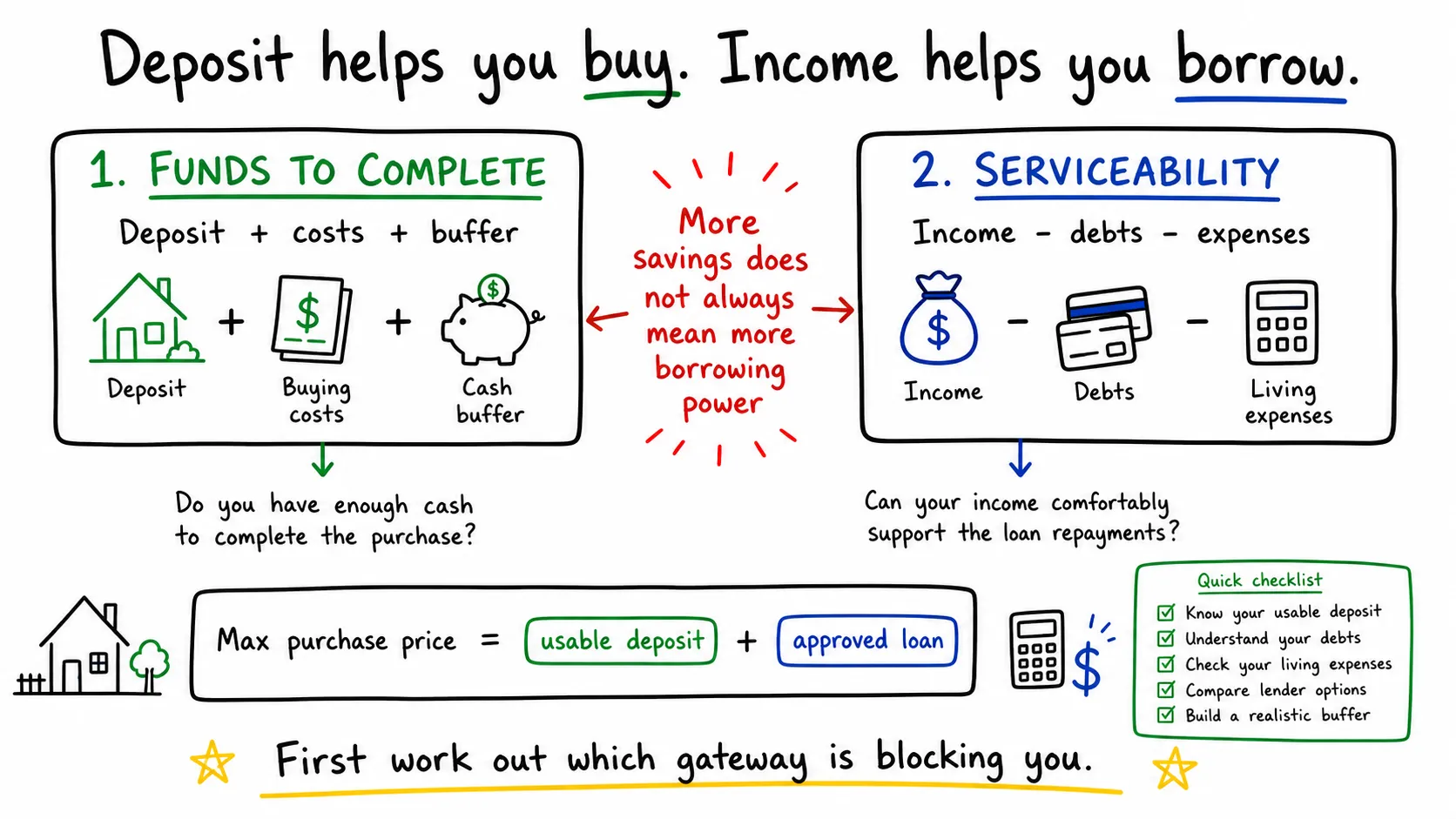
The two gateways
Most first home buyer conversations eventually come back to two separate questions.
You need both gateways to work. Saving more deposit can help with the first gateway. It does not automatically fix the second.
Why saving more cash does not always lift your borrowing power
A common question is: if I save another $20,000, how much more will the bank lend me?
The annoying answer is often: not much.
Extra deposit can help with funds to complete. It can help with LMI, genuine savings, stamp duty, grants, concessions, cash buffer and fitting into certain low-deposit pathways.
But once you have enough money to complete the purchase you want, that box is mostly ticked. From there, saving more cash does not magically increase what the bank thinks you can afford each month.
What affects borrowing power instead?
Borrowing power is mostly a serviceability question. Lenders are looking at whether the repayments make sense after allowing for their assessment rules.
- Income and employment type.
- Existing debts and repayment commitments.
- Credit card limits, even if the card is rarely used.
- HECS or HELP debt.
- Dependants and household structure.
- Living expenses.
- The lender's assessment rate and policy settings.
So if your income, debts and expenses mean the bank will only let you borrow $700k, saving another $20k does not necessarily make the bank lend you $750k. It may just mean you have $20k more cash.
That can still be useful. More buffer is good. A lower loan amount can be good. Less stress is good. It is just not the same thing as increasing borrowing power.
Are you deposit-limited or servicing-limited?
A lot of the strategy is working out which gateway is actually blocking you.
If you are deposit-limited, then grants, concessions, genuine savings policy, LMI rules, family guarantees and low-deposit schemes may matter a lot.
If you are servicing-limited, then the focus is more likely to be income, debts, credit limits, HECS, dependants, lender choice and how different banks assess your situation.
A quick checklist before you keep saving
- Do you know your realistic purchase price range?
- Do you know your usable deposit after costs?
- Have you checked whether LMI, grants or concessions apply?
- Do you know whether your borrowing capacity is the actual blocker?
- Would paying down debt help more than keeping every dollar in savings?
- Have you checked more than one lender policy?
The goal is clarity
The goal is not just "save more deposit". The goal is to work out which gateway is stopping you, then build the plan around that.
Different lenders do not all assess things the same way, and small policy differences can change the practical path forward.