
People overthink the home lending process. I say that with sympathy, and with some authority: before I was a broker I was a credit assessor at a bank, sitting on the other side of the applications.
Underneath all the paperwork, a bank assessing your loan is trying to answer two fundamental questions. Their credit policy, all of it, is just a framework for answering them according to the kind of customers that bank wants. Risk appetite is the fancy bank word for that.
Question 1: will they get their money back?
The bank's biggest concern is recovering its money if everything goes wrong. The main metric here is the loan-to-value ratio, LVR: how much they are lending against what the property is worth.
When they look at the property, they are asking: what is it actually worth, where is it, and how easily could it be sold if it came to that. The higher the loan relative to the value, the riskier the deal, which is why higher LVRs attract higher rates, lenders mortgage insurance, or a request for a guarantor.
This is also why deposits, family guarantees and LMI all make banks more comfortable: every one of them reduces the bank's risk of losing money. And it is why lenders have policies about location, property size, zoning and use. Those rules look arbitrary from outside; from inside they are all the same question about resale.
Question 2: can you actually afford the repayments?
The bank does not want to repossess your property. It is a hassle for everyone. They want a customer who quietly makes repayments so they collect their interest.
Serviceability is what is left of your income after your expenses and existing debts. That is what can pay a mortgage. Banks love straightforward employment because it is predictable income. Self-employed income is not worse, it is just less guaranteed on paper, so lenders ask for more proof to get comfortable. The less predictable the income, the more the bank needs to see.
Lenders also stress test you: they assess your repayments at a buffer of around three percentage points above the actual rate. If rates are 6%, they check whether you could cope at roughly 9%. That is why your borrowing capacity is lower than your own budget says it should be. It is not the bank doubting you; it is the bank pricing in a future that might be worse.
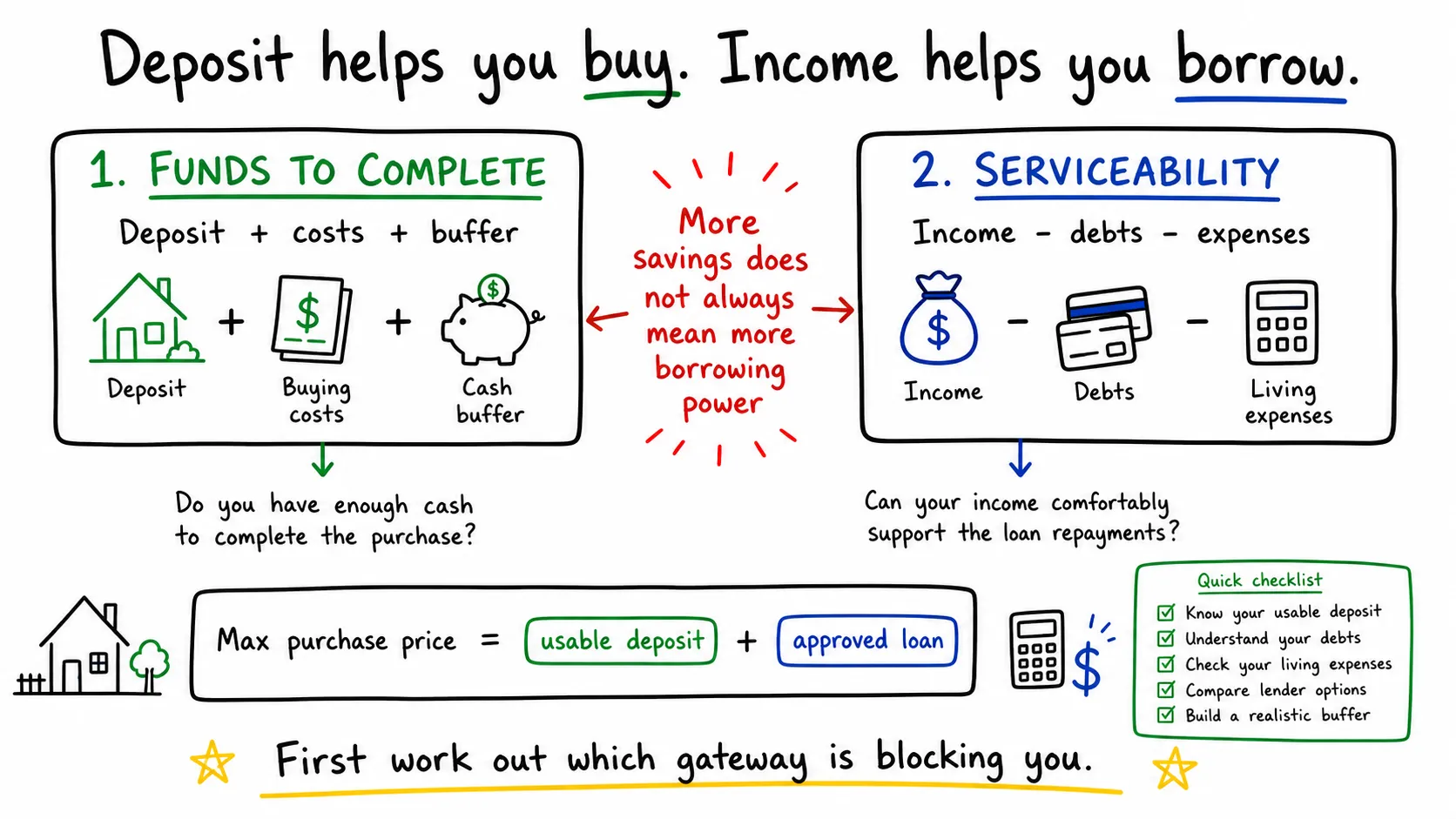
Everything else hangs off these two
- Credit history feeds question 2: it is evidence about whether you repay things. A good score will not qualify you, but a bad one can disqualify you. More on that in the credit score article.
- HECS is not a black mark. It is just a liability: the compulsory repayments come out of your pay, so they sit in the calculation as an expense and trim your borrowing power. That is the entire effect.
- Genuine savings rules are about question 1: lenders like to see the deposit has history, though acceptable sources are broader than people think (savings, shares, asset sales, gifts with a letter, the First Home Super Saver scheme, depending on the lender). Once your deposit reaches 20%, most lenders relax about its provenance considerably.
- Debt-to-income ratios are one more lens on question 2. Not the whole picture, but a very high DTI usually means the answer to "can you afford it" is no.
If it helps to see it, I've drawn both questions out as the two gates, one step at a time.
Three myths the comments keep busting
I posted this on Reddit and a couple of hundred thousand people read it. The discussion settled three persistent myths, including one confirmed by someone who works in bank credit policy:
- "The bank will judge my kebab habit." Transaction history is mostly trivial in assessment. Assessors know discretionary spending gets cut when things are serious. What they actually look for is undisclosed debts and repayment stress, not your food delivery orders.
- "Banks want to foreclose." They really do not. Repossession is rare, expensive and bad news for everyone involved. The bank is in the money business, not real estate.
- "I need to build credit history first." Australia is not America. Plenty of first home buyers with no credit history at all get approved. If the two fundamentals are solid, the empty credit file is fine.
What to do next
Look at your own situation through the two questions. If the deposit side is the problem, your levers are savings, schemes, family help and price range, and the numbers are unpacked in deposit vs borrowing power. If the serviceability side is the problem, your levers are income, debts and expenses. If both look fine, the next step is pre-approval, where a lender formally agrees with you.