Self-employed income is one of the places where borrowers and banks can see the same person very differently.
The classic example is someone who owns a company and pays themselves a regular wage. From their point of view, they are getting payslips, so it feels like normal PAYG income. From the bank's point of view, it can be more complicated because the borrower controls both sides of the equation.
That does not mean self-employed borrowers cannot get home loans. Plenty do. It just means the income usually needs a cleaner story.
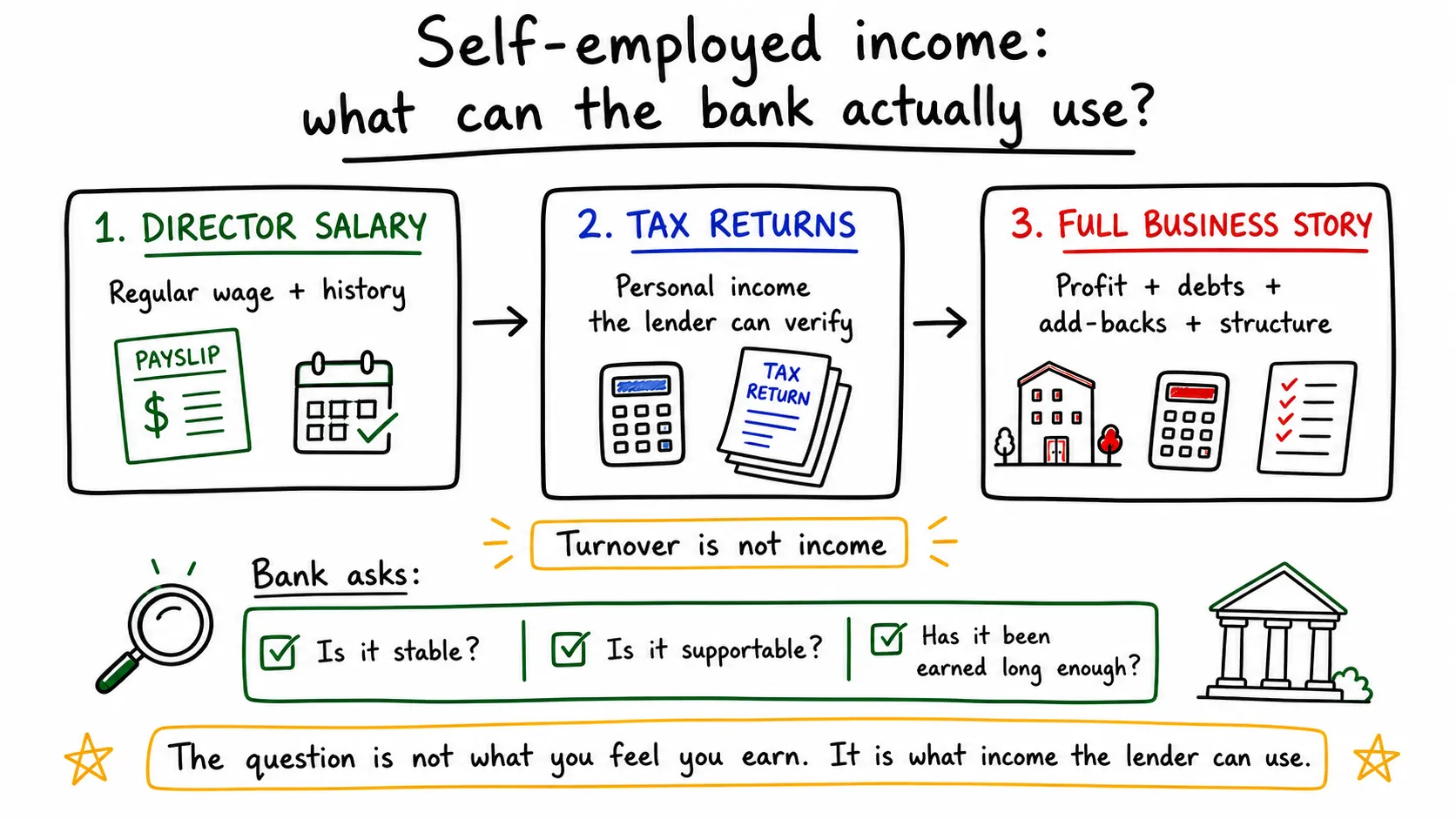
The bank is asking a different question
For a normal employee, the lender is mostly asking: are they employed, and what are they paid?
For a self-employed borrower, the lender is usually asking: does the business actually make enough money, and has it done that for long enough?
Three broad ways lenders may assess the income
1. Director salary
This is often the cleanest version when it works. You own the company, pay yourself a regular wage, and the lender is comfortable using that wage without needing to rely heavily on the business profit.
The catch is history. You usually cannot start paying yourself a much larger salary right before applying and expect every lender to treat it like a normal job. The lender wants the wage to look real, consistent and supportable.
2. Basic self-employed assessment
Some lenders may mainly look at personal tax returns and notices of assessment. A simple version could involve using an average of recent personal income, or using one year where the policy allows it.
This can work well when the personal income tells a clean story. It can be limiting when the business structure is more complex, or when income is flowing through a company, trust, partnership or mix of entities.
3. Full self-employed assessment
This is where the books get opened. Personal tax returns, company tax returns, trust returns, profit and loss statements, balance sheets, business debts, wages, distributions, add-backs and retained profits can all become relevant.
The point is not to punish business owners. The point is to work out what income is actually available to the borrower.
The mistakes that catch people out
The first mistake is assuming that because you pay yourself a wage, the bank will always treat you exactly like a standard employee. Sometimes that is possible. Sometimes the lender still needs to understand the business behind the wage.
The second mistake is assuming your strongest year is automatically the year the bank will use. Some lenders may use one year. Some may want two years. Some average. Some take the lower year. Policy matters a lot here.
The third mistake is forgetting about business debts. One lender may include a business debt in your personal servicing calculation. Another may be more comfortable excluding it if the business is clearly paying it. That one policy difference can change borrowing capacity by a lot.
The fourth mistake is thinking tax minimisation and borrowing capacity always like each other. They often do not. Reducing taxable income can make sense for tax planning, but a lender can only use income they can verify and accept under policy.
A practical self-employed loan checklist
- How long has the business been trading?
- Is the income stable, rising or falling?
- Are you paid wages, dividends, trust distributions, business profit, or a mix?
- Are there business debts the lender may need to include?
- Do the tax returns tell the same story as the bank statements and accounts?
- Would a different lender assess the income more favourably?
What to do before applying
If you are self-employed and thinking about buying or refinancing, it is worth checking your income position before you fall in love with a property.
The useful step is getting clear on what story the documents actually tell, then matching that to lenders that are more likely to understand the structure.