
When you make a normal offer on a property, you can attach protections. A finance clause. A building and pest clause. Cooling-off rights, depending on the state. If something goes wrong between the offer and settlement, those clauses are your exits.
When you win at auction, you are usually buying unconditionally. No finance clause, no building and pest clause, no cooling-off, and the deposit is usually due on the day. You are buying the property as-is, and the moment the hammer falls, the risk moves to you.
That is not a reason to never buy at auction. Plenty of first home buyers do it well. It is a reason to understand exactly what you are taking on, and to do the boring work before auction day rather than after it.
The bank valuation is not there to validate what you paid
This is the piece that surprises buyers most. The bank valuation is not there to confirm you paid a fair price. It is there to tell the bank what they are comfortable lending against.
Say you win at $800k, planning to borrow 80% of the price. That is a $640k loan. Then the valuer looks at the property, looks at the market, and says: $750k.
The bank lends against its valuation, not your winning bid. 80% of $750k is $600k. You now need to find an extra $40k in cash, or a different lender, or a miracle.
What you cannot do is simply pull out because the valuation came in short. You bought unconditionally. Same property, same bid, and now a $40k problem has arrived after the hammer has fallen. And it arrives on top of the buying costs you were already planning for.
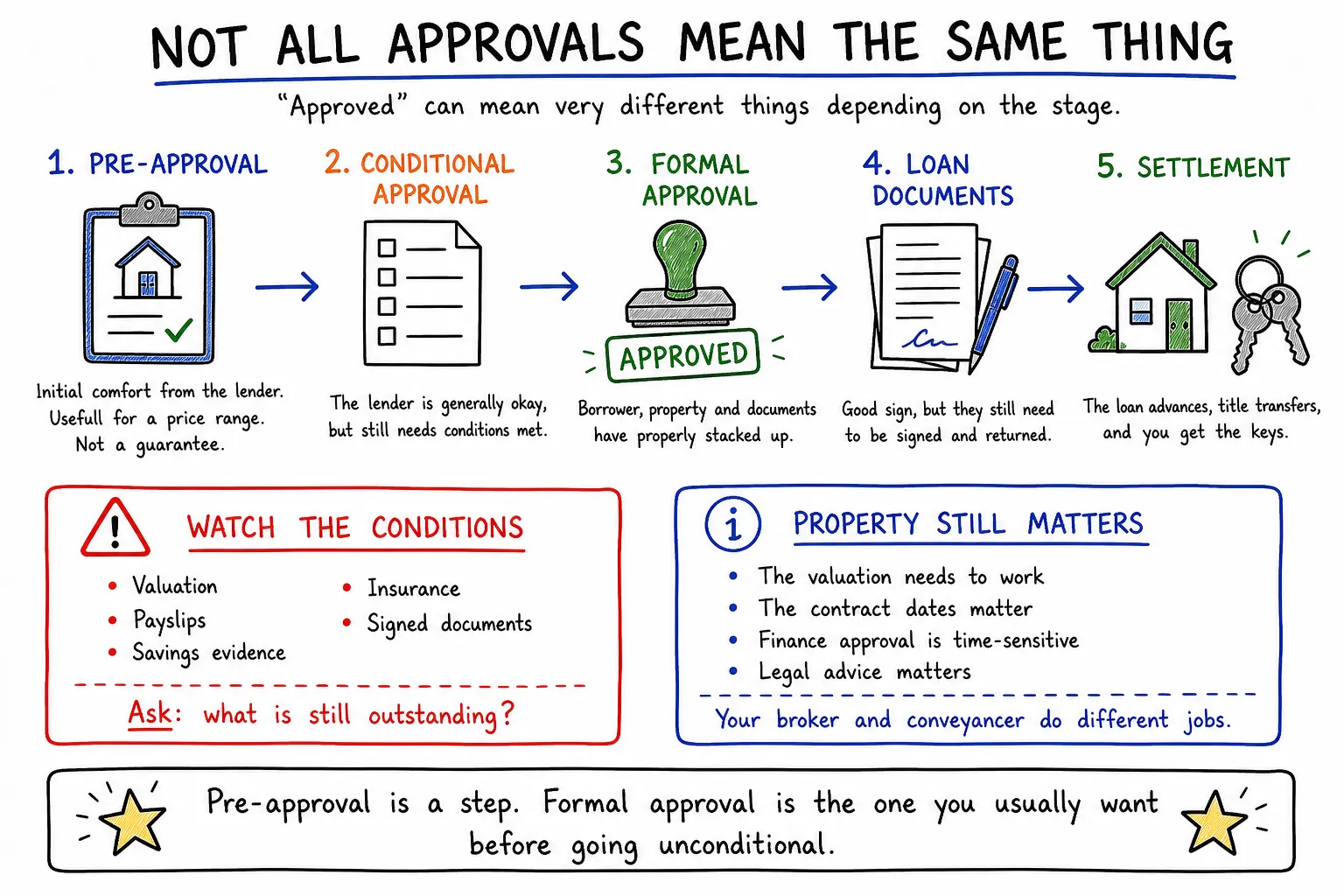
Doesn't the bank just accept the auction price as the value?
Often, yes. A competitive auction with live bidding is decent evidence of market value, and depending on the lender and how much you are borrowing, the contract price may be accepted without a full valuation.
But that is a lender policy, not a law of nature. It can depend on your loan-to-value ratio, the property type, the location and the lender's current appetite. And policies like that tend to get revisited when the market softens.
How often do valuations actually come in short?
Honestly, not often. In my experience it is rare, and most of the time the valuation meets the contract price and nobody ever thinks about it again.
The reason I keep explaining this risk anyway is that it behaves like a tail risk. It is unlikely, but when it lands it is expensive, it lands at the worst possible moment, and it is more likely in exactly the conditions where buyers feel they got a bargain: a softening market, weaker clearance rates, valuers getting more conservative about where prices are heading.
A rare problem you cannot exit from deserves more respect than a common problem you can.
The same problem with an exit built in
Compare what happens when the protections exist. I had clients offer on a $400k property in a country town, with a finance clause on the offer. The valuation came in at $320k. They thought about it, decided they did not want the property anymore, and walked away clean.
Same shaped problem, completely different ending, because the offer had an exit built in.
The homework that has to happen before auction day
If you are seriously considering bidding at auction, the work all moves to before the day. A useful pre-auction checklist looks like this:
- Get the pre-approval done properly. The borrower side of the assessment should be as far along as it can be before you bid, because the property side only gets assessed after you are committed.
- Have your broker look at the property beforehand. Some properties carry easy lender policy flags: size, location, property type. Better to find them before you bid than after.
- Read the seller's building and pest report if there is one, and seriously consider paying for your own. A few hundred dollars to find out it is not a dud is cheap compared to finding out after you own it.
- Get the contract reviewed before you bid. A conveyancer can deal with pre-auction enquiries, negotiate contract clauses ahead of time, check zoning and building certificates, and flag any duty surprises. A broker and a conveyancer working together before auction day is the strongest position a bidder can be in.
- Set your limit with built-in redundancy. Extra cash left over. A plan for what happens if the valuation lands short. A clear understanding of whether another lender might be an option.
The boring message that saves real money
One more thing, because it costs people real money outside auctions too. I had a buyer pre-approved at $700k who bought at $720k without checking in first, because he figured it would just work.
It did work, eventually, but only by moving to a lender where he paid lenders mortgage insurance and a higher rate. He was happy, and he understood the trade-off, but a two-minute message would have shown him the real cost of that extra $20k before he committed to it.
The most boring message you can send your broker is: "Here's the property, here's my number, does everything still work?" It is also one of the most valuable ones.
A word on finance clauses generally
Put one on every offer you can. Going unconditional can genuinely strengthen an offer, and sometimes it is worth money off the price. But it is a move you make from strength, when servicing is comfortable, the numbers have been checked, and you have talked it through. Not a default you drift into because the agent made it sound normal.
The better question before auction day
The question to ask before auction day is not just, "Can I afford this property?"
It is, "If the valuation lands short after the hammer falls, what is my plan?"
If you can answer that one calmly, with real numbers for your cash to complete and a buffer that survives a surprise, you are in a much better position to bid than most of the room.
If you have not run those numbers yet, my free cost to complete calculator estimates stamp duty, government costs and the total cash you may need at your bidding limit. Worth doing before auction day, not after.