One thing I talk about a lot with first home buyers is that there are basically two gates you need to get through when buying.
The first gate is: can you afford the loan?
That is the bank looking at your income, debts, living expenses, credit cards, dependants, HECS, and all the other fun stuff that goes into serviceability.
The second gate is: do you have enough money to complete the purchase?
That is your deposit, stamp duty if applicable, government fees, conveyancing, building and pest, lender fees, settlement adjustments, and ideally some kind of buffer so you are not completely cleaned out after settlement.
They sound connected, but they are not always the same problem.
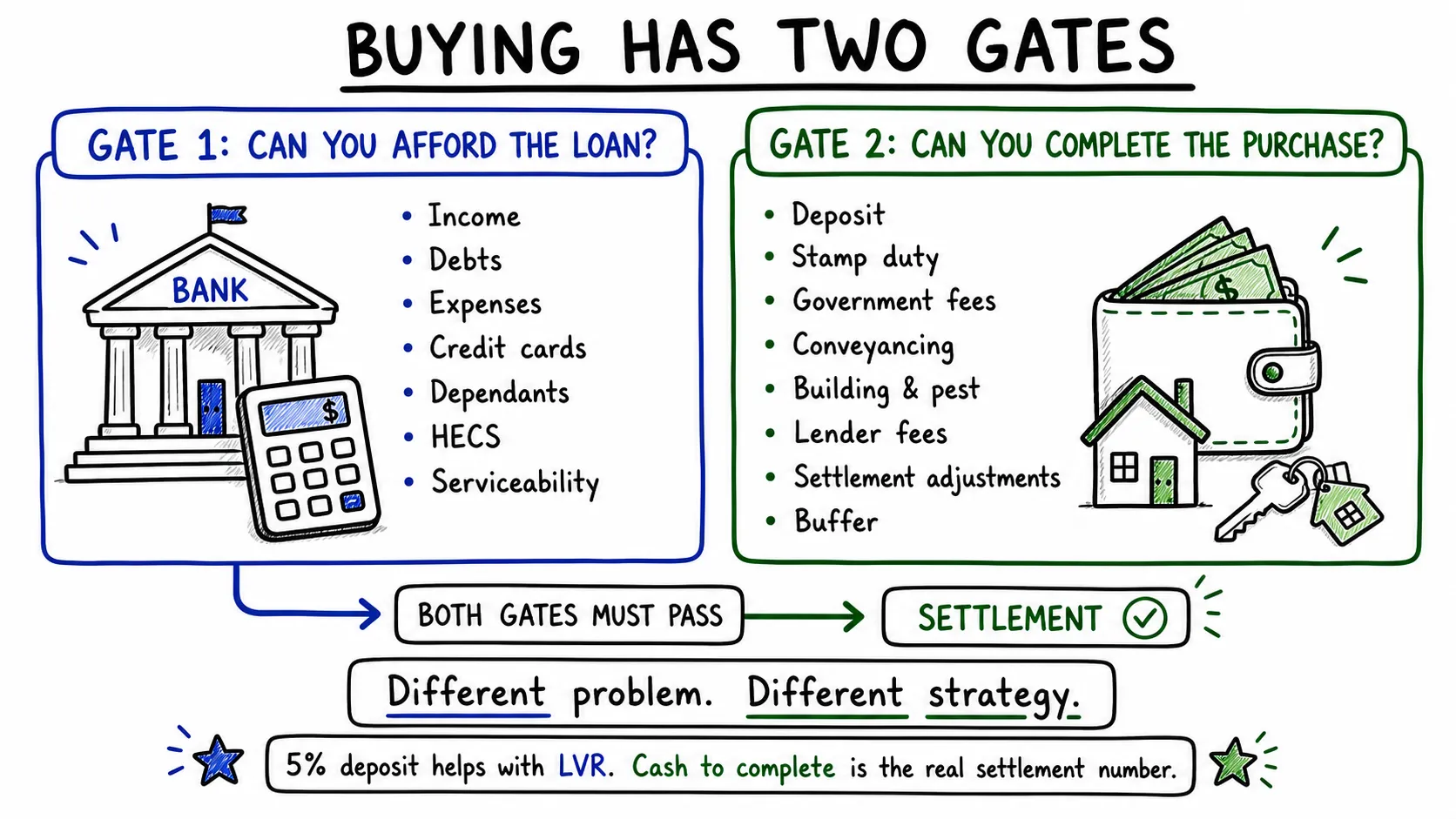
The two gates are different
Some buyers have enough income, but not enough cash. Some buyers have enough cash, but not enough income. Some are short on both. Some are fine on both and just need the right lender.
Where first home buyers can get caught is with the second gate.
They hear "5% deposit" and think:
"I am buying for $600k. 5% is $30k. I need $30k."
That might be true in some cases, but it is not always the full story.
What the lender means by a 5% deposit
When lenders talk about a 5% deposit, they are usually talking about the loan-to-value ratio, or LVR. In normal English, that just means how much the bank is lending compared to the value of the property.
So if you buy for $600k and borrow $570k, that is a 95% lend. Your 5% deposit is $30k.
But that does not automatically mean $30k is the full amount needed to buy the property. The bank is generally lending against the property value. It is not necessarily giving you 95% of the property plus stamp duty plus conveyancing plus every other buying cost.
What cash to complete usually includes
Cash to complete is the real settlement number. It is the money that needs to be available once the purchase price, loan amount, government costs and other buying costs are all put together.
A simple way to think about it is:
- Deposit or cash contribution toward the property.
- Stamp duty or transfer duty, if it applies after concessions.
- Government registration and transfer fees.
- Conveyancing or solicitor costs.
- Building and pest inspections, if relevant.
- Lender fees, valuation fees or settlement-related fees.
- Settlement adjustments, such as rates or water adjustments.
- A buffer after settlement so you are not left with nothing.
The exact list depends on the property, state, lender and your situation. The point is that the 5% deposit is only one part of the cash conversation.
A simple example
Let us say you buy for $600k.
Your 5% deposit is $30k.
But let us say there is also $12k in stamp duty and government costs after any concessions, plus another $3k in conveyancing, building and pest, bank fees and other bits and pieces.
Now you do not need $30k. You need closer to $45k before buffer.
If you also want $5k left over after settlement, the real number is closer to $50k.
Same property. Same 5% deposit. Different actual cash needed.
Why a higher purchase price can hurt more than expected
This is also why increasing your purchase price can do more damage than people expect.
A buyer might go from $600k to $650k and think, "That is only another $2,500 deposit at 5%."
But depending on the state, concessions, thresholds and other costs, the cash needed might move by more than that.
The extra price may change the deposit amount. It may also change duty, scheme eligibility, concessions, lender requirements, or the amount of buffer left after settlement.
That is why the better question is not just, "How much can I borrow?"
It is also, "How much cash do I need to complete at that price?"
The 5% Deposit Scheme can help, but it does not remove every cost
The Australian Government 5% Deposit Scheme can be a massive help for eligible buyers. It can reduce the deposit hurdle and may help eligible first home buyers avoid lenders mortgage insurance.
But it does not magically remove every other cost involved in buying.
You still need to qualify for the loan. You still need to meet lender policy. You still need to buy under the relevant property price cap. You still need to cover the buying costs that apply to your situation.
And if the lender's valuation comes in lower than the contract price, that can also change the numbers.
Three deposit conversations that get mixed together
Part of the confusion is that people use the word deposit in different ways.
The deposit you pay under the contract is one thing. That might be 5%, 10%, or sometimes something negotiated differently.
The deposit the lender talks about is usually your contribution toward the purchase price for LVR purposes.
Cash to complete is the real settlement number.
Those three things can overlap, but they are not exactly the same thing.
Questions to ask before you sign
Before you sign a contract or stretch your price range, it is worth knowing the real numbers.
- At this purchase price, what is the total cash needed to complete?
- What stamp duty or transfer duty actually applies after concessions?
- Are any grants available, and are they available before settlement or after settlement?
- What happens if the price goes up by $25k or $50k?
- What happens if the lender valuation is lower than the contract price?
- How much money will be left after settlement?
Different problem, different strategy
When I am looking at a first home buyer's numbers, I am usually trying to work out which gate is the actual problem.
If the income is the issue, we are dealing with borrowing capacity.
If the cash is the issue, we are dealing with deposit and cash to complete.
Different problem. Different strategy.
A 5% deposit does not always mean you only need 5% cash. The bank cares about LVR. You need to care about cash to complete.
Use the cash-to-complete checklist to identify every line first, then put your price and state through the calculator.