Buying a first home has two main barriers: having enough income to service the loan, and having enough deposit to get approved. A family guarantee is designed for buyers who clear the first barrier comfortably but keep hitting the second.
Banks generally want a 20% deposit before they will skip lenders mortgage insurance and treat you as lower risk. Saving that while renting is the hard part. A family guarantee solves it a different way.
The structure: two loans, not one
With a family guarantee you can potentially buy with no deposit, because the lending is split into two loans.
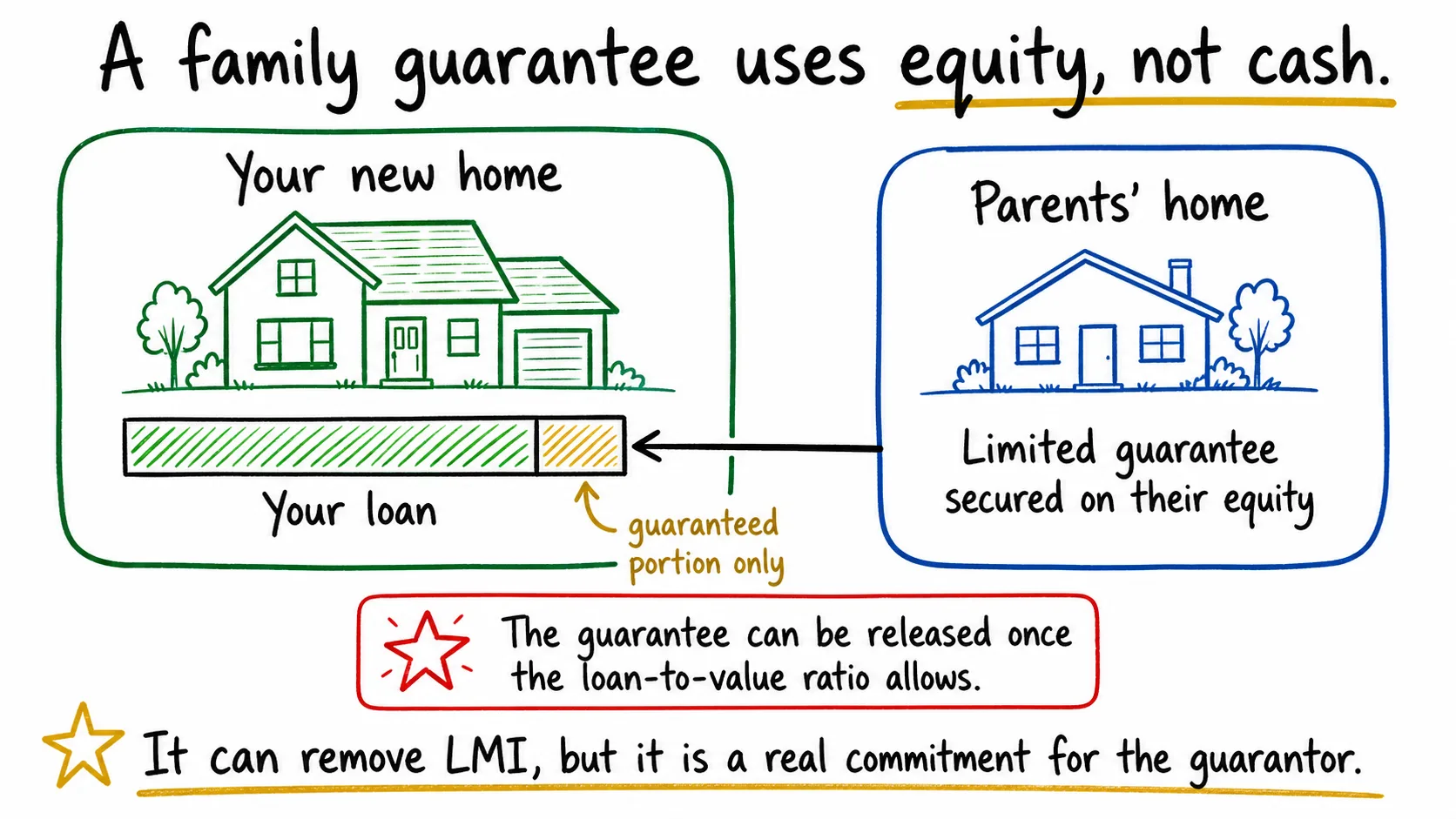
Loan A, roughly 80% of the purchase, is secured only by the property you are buying. Loan B, the remaining 20% plus costs, is secured by both your new property and your guarantor's property.
Simplified example on a $1,000,000 purchase, borrowing the lot: Loan A is $800,000 secured against your new home; Loan B is $200,000 plus costs, secured against your home and your parents' property together.
Your parents are not borrowing money, not gifting money, and not making repayments. They are providing security for a defined slice of your loan. That is the whole trick: it uses their equity, not their cash.
Why the bank is happy with this
The bank's concern is always getting its money back. In this structure, Loan A sits at 80% LVR on your property, which is acceptable risk, and Loan B has security over two properties. From the bank's chair, the deal is safe enough to skip LMI and offer sharper pricing than a small-deposit loan would get.
That LMI saving is not small. At high lending amounts the premium can run into tens of thousands of dollars.
What the guarantor is actually risking
The guarantor's liability is capped at the guaranteed portion, Loan B. In the example above, that is $200,000 plus costs, not the full million. If your property sold short by more than the guaranteed amount, the remaining shortfall is yours, not theirs.
In the clean version of the story, if everything goes wrong the bank sells your property first, the proceeds clear Loan A and then go towards Loan B, and the guarantor only covers whatever is still short on Loan B, from savings or a loan before their property would ever be sold.
But here is the part I want every parent to read, because a lawyer who advises guarantors made exactly this point when I published the original version of this piece. Whether the bank must exhaust the borrower's property before touching the guarantor's depends on the loan documents, and many lenders reserve the right to enforce against the guarantor directly. Default events can also be broader than just missed repayments. This is precisely why lenders recommend, and some require, that guarantors get independent legal advice before signing. Take that advice seriously; it is not a formality.
What a family guarantee does not do
It does not help with servicing. You still need to demonstrate you can make repayments on the full loan amount with your own income. Your parents guaranteeing the loan changes the security question, not the affordability one. If your income cannot carry the total lending, the guarantee does not move that answer at all.
As a very rough shape: borrowing $1,000,000 needs the income to service $1,000,000, whatever rules of thumb like four-to-five-times-income suggest for your circumstances. The deposit barrier and the income barrier are different problems, and this tool only touches one of them.
The release: this is not forever
The guarantee is designed to be temporary. Once your property value rises or your loan balance falls enough that the loan sits at 80% LVR on your property alone, the guarantor can be released. In practice that often happens within two to five years: you have the property revalued, the numbers stack up, and the second security is discharged.
Put the release on the calendar as a deliberate goal, not something you hope happens. Every extra repayment and every bit of value growth is progress towards getting your parents off the loan.
Questions people always ask
- Can I still get first home buyer benefits? Generally yes. A guarantee does not disqualify you from stamp duty concessions or first home owner grants. You would not combine it with the government's low-deposit guarantee schemes, but that is because you would not need to.
- Do my parents need a mortgage? No. They just need to own property with enough equity. Owning it outright is fine.
- Can it cover just part of the deposit? Structures vary by lender: some deals guarantee a smaller slice on top of your partial deposit. Some combinations, like stacking a guarantee on top of a professional LMI waiver, may not be allowed. This is exactly the kind of policy question that differs lender to lender.
A word to the parents
One of the wisest comments on the original thread came from a parent: they would only ever guarantee an amount they were genuinely prepared to lose, on the logic that if things went wrong, better to lose some savings than both homes, and the kids can always move back in.
That is the right spirit. Keep the guarantee limited, understand the worst case in dollars, get the independent legal advice, and treat the release date as part of the plan. Done that way, a family guarantee is one of the most powerful tools a family has for getting a first home buyer into the market. Done casually, it is a risk nobody priced.
What to do next
If the deposit is your barrier and your family is open to helping, start by working out the actual numbers: what you can service on your income, what slice would need guaranteeing, and what the release path looks like. If you are not sure whether deposit or income is your real constraint, this explainer will sort that out first.